Tessellations, Patterns and Tiles
A tile series in cast metal, glass and cultured marble
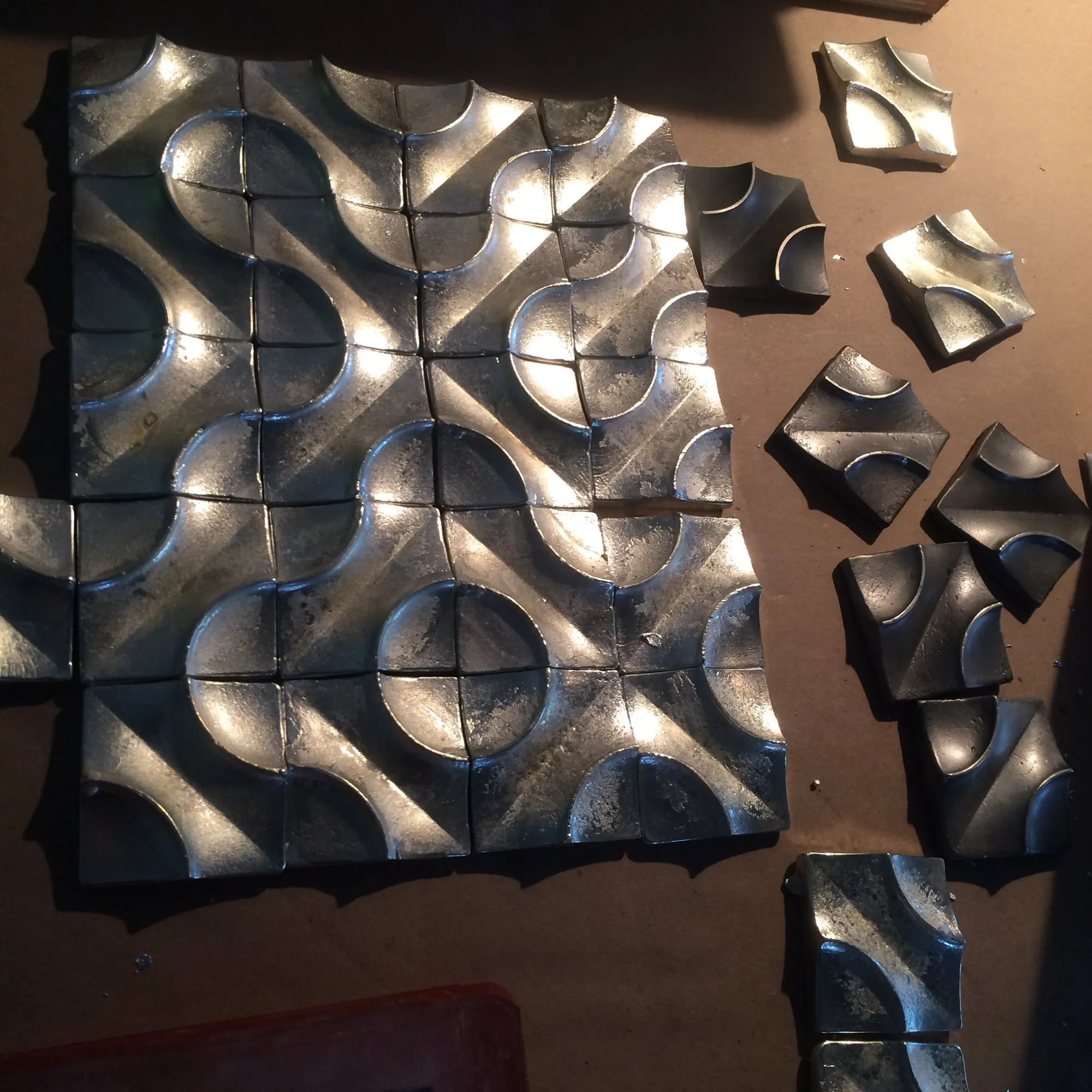
A single tile, turned four ways, can produce more patterns than a designer can draw.
The French mathematician Sébastien Truchet described this in 1704: a square divided by a simple motif, rotated and repeated, generates a field of forms that no one explicitly composed. This series asks what happens when that idea leaves the plane. The Truchet tile here is extruded into relief, with a defined crease at its center rising to two narrow ridges, so that the pattern is made of light and shadow as much as of line.
The series was developed at ChiLab Design Studio for an installation in the Mayor’s office in Chicago, installed in spring 2016. It draws on old and new approaches to tile at once: geometric studies built parametrically, molds routed by machine, and casting in cultured marble, pewter, bronze and glass.
The challenge is tolerance. A pattern that depends on curves meeting across every edge has no forgiveness in it, and each material shrinks, flows and finishes differently. What the series offers is a method: a small number of carefully controlled units that produce variety through arrangement.
The same interest in rule-based form runs through the Parametric Feature Wall and through tile projects set for students in studio courses.